Racing Simulator Motion Platform
Actuator design
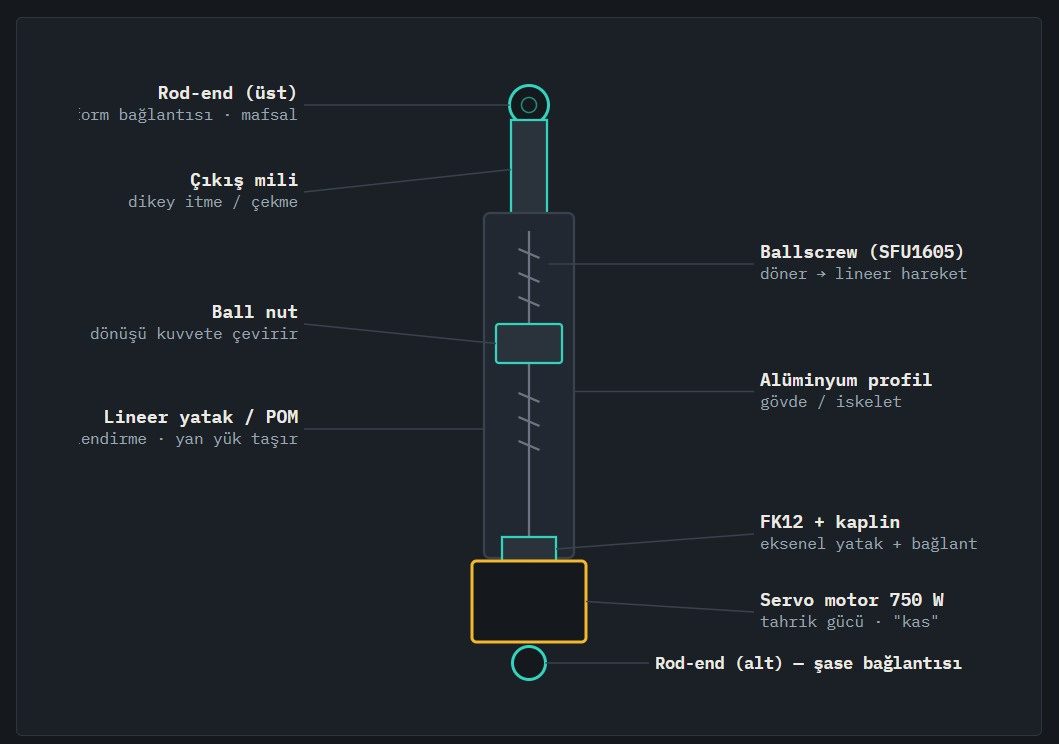
Each actuator converts the servo motor's rotation into linear push and pull through an SFU1605 ballscrew. Side loads are carried by a linear bearing and POM bushings; the motor connects via an FK12 axial bearing and a coupling. Rod-end joints at the top and bottom leave the changing angle between platform and chassis free: without them the ballscrew would take a bending load and burn through its service life.
Engineering decision
I compared 3DOF and 4DOF architectures and derived centre-of-gravity-aware torque calculations; because driver weight and seat position set the torque requirement directly, that calculation drove the entire configuration choice.
The latency problem
On motion platforms perceived quality depends directly on latency. To remove the telemetry chain that runs through the PC I developed a standalone ESP32 + UDP telemetry architecture, cutting a layer out of the command path and reducing end-to-end latency.