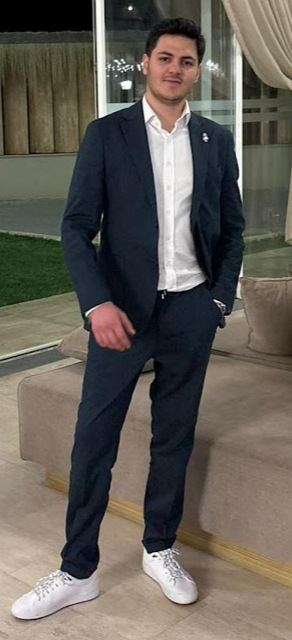
I started in mechatronics and ended up in software, and the route between the two is the reason I work the way I do.
At Atılım University I studied mechatronics engineering, which meant motors, sensors, control loops and the uncomfortable fact that everything you design has to survive contact with a physical object. In 2021 I joined Digitest as a long-term intern and was put on a target detection and tracking pipeline running on NVIDIA Jetson developer kits. That work became my undergraduate capstone project, then my job. I have been doing versions of it ever since.
What I actually do
I write computer vision that has to run on a device.
That sentence carries more weight than it looks. Getting a detector to a good mAP on a workstation is a solved problem most weeks. Getting the same detector to hold up on an embedded board with a fixed power budget, a camera that moves, and a hard latency ceiling is a different discipline. It pushes you into C++ and CUDA, into thinking about memory copies and thread boundaries, into questions about whether your training resolution matches your export resolution. Most of the interesting failures I have debugged live in that gap between the notebook and the board.
The other half of the work is data. At Atılım UAV I lead a five-engineer software team building the vision and autonomy stack for a competition UAV, and the single highest-leverage thing I did there was not a model change. It was designing the tiling and train/validation split so the model could not cheat, then reading the training curve honestly enough to conclude that we had hit a data ceiling rather than a training-time ceiling. Models are cheap. Correctly built datasets are not.
Where I have worked
Digitest Defence and Aerospace, from 2021 to 2024, in a six-to-ten person software team: detection in C++, tracking in Python, operator interfaces in Qt Creator, parallel pipelines with multithreading, CUDA C and OpenMP, all integrated on Jetson with a TCP/UDP/UART transport layer underneath.
Wupsoft Defence and Aerospace since 2024, as a senior software engineer and XR/VR instructor, working on mixed reality applications, MATLAB simulation modelling for an externally funded ballistics project, and large-data visualisation in XR. I have also delivered XR development training to groups of six to twenty engineers, which turned out to be the fastest way to find the holes in my own understanding.
Alongside that I take freelance work. Right now that means ball and player tracking from single-camera football footage for a France-based sports technology client, and before that a multi-vendor marketplace backend where the interesting problems were all about money moving correctly rather than about vision.
What I am doing now
I am writing my MSc thesis in software engineering at Atılım University on measuring user stress through a biocybernetic loop in virtual reality, where the environment adapts itself to biosignals read from the user. It sits at the intersection of XR, signal processing and adaptive systems, and it has direct application in simulation and training.
I am also leading the software team for the RoboNation SUAS 2026 competition in Tulsa, Oklahoma, this September.
Outside work
I shot competitively for four years and captained the university archery team, which is where I learned that consistency beats intensity. I cook, I write the occasional poem, I hike, and I lose more strategy games than I win.
Working with me
I am in Ankara. I am most useful on problems where the vision has to be correct and has to fit on real hardware, and I am most interested in the ones where nobody has yet worked out which constraint is going to bite first.
The fastest way to reach me is email.
Off the screen
I used to practice archery and HEMA (historical European martial arts); these days the reset button is hiking and cycling. I write poetry and play video games. I follow technology and speculative fiction, and I like reading philosophy and theology. Coffee culture is a serious interest: a good cup and a pipe are part of how I think. I also create content as an amateur.
I am socially active, but the battery drains fast; time alone at home is where it recharges. Sport and walking clear my head and sharpen my focus. When there is time I join university projects and run engineering side projects of my own: most of my new ideas come from exactly there.